
NASA Logo, National Aeronautics and Space Administration
header

Goddard Collaborates With International Partners on MMS Instrument

Goddard Collaborates With International Partners on MMS Instrument

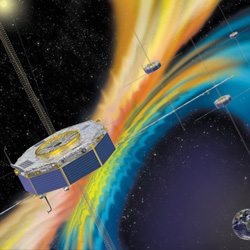
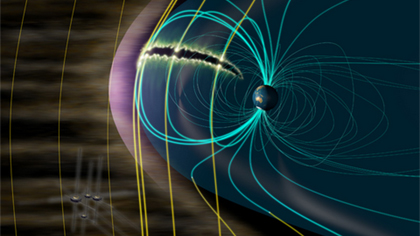
04.30.12 – Whether it's a giant solar flare or a beautiful green-blue aurora, just about everything interesting in space weather happens due to a phenomenon called magnetic reconnection. Reconnection occurs when magnetic field lines cross and create a burst of energy. These bursts can be so energetic they could be measured in megatons of TNT. To study this phenomenon, NASA is readying a fleet of four identical spacecraft, the Magnetospheric Multiscale (MMS) mission, for a planned launch in 2014.

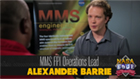
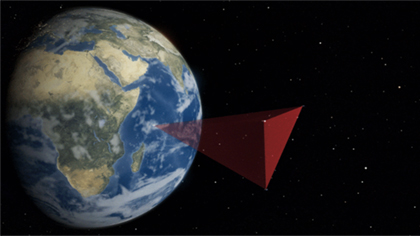
At NASA's Goddard Space Flight Center in Greenbelt, Md., a team of scientists and engineers are working on a crucial element of the MMS instrument suite: the Fast Plasma Instrument (FPI). Some 100 times faster than any previous similar instrument, the FPI will collect a full sky map of data at the rate of 30 times per second -- a necessary speed given that MMS will only travel through the reconnection site for under a second.

>> Read More


The Magnetospheric Multiscale (MMS) mission is a Solar Terrestrial Probes mission comprising four identically instrumented spacecraft that will use Earth's magnetosphere as a laboratory to study the microphysics of three fundamental plasma processes: magnetic reconnection, energetic particle acceleration, and turbulence. These processes occur in all astrophysical plasma systems but can be studied in situ only in our solar system and most efficiently only in Earth’s magnetosphere, where they control the dynamics of the geospace environment and play an important role in the processes known as “space weather.”

Press Releases

01.13.12Spacecraft Cleanroom Goes Green
04.29.11Goddard Building Instrument To Study Reconnection
10.01.10Q&A: Missions, Meetings, and the Radial Tire Model of the Magnetosphere
09.03.10NASA’s Magnetospheric Mission Passes Major Milestone
07.21.09NASA’s Magnetospheric MultiScale Mission Takes a Step Closer to Solving the Mystery Behind Magnetic Reconnection
12.19.08NASA Goddard and University of Idaho Create Solutions for 2 NASA Missions

>> Go to Newsroom

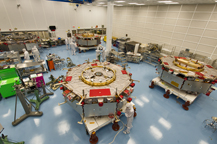
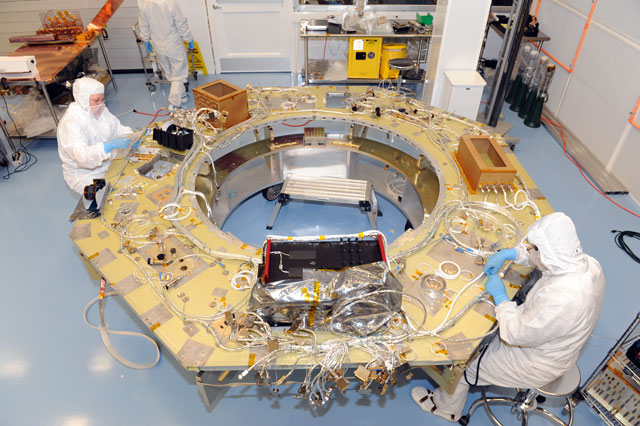
Spacecraft Assembly Images

NASA Engineers celebrate the teamwork necessary to build the first of four flight Power Systems Electronics and Engine Valve Driver System (PSEES) chassis.

Multimedia

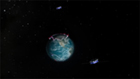
MMS Orbit Animation

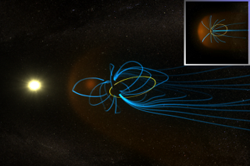
This animation shows the orbits of Magnetospheric Multiscale (MMS) mission, a Solar Terrestrial Probes mission comprising of four identically instrumented spacecraft that will study the Earth’s magnetosphere.

>> View Movie


Earth’s magnetosphere as a laboratory to study the microphysics of magnetic reconnection


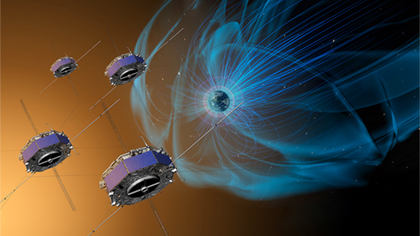
MMS Spacecraft in formation

The Magnetospheric Multiscale mission will use four identical spacecraft, variably spaced in Earth orbit, to make three-dimensional measurements of magnetospheric boundary regions and examine the process of magnetic reconnection. Credit: Southwest Research Institute

Mission Status

Launch Readiness Date (LRD): August 2014
Phase C/D: Design & Development
Mission Highlights – As of April 26, 2012:

  • Across the board integration is in progress for Observatory #1 instrument and spacecraft systems while the production and testing of instruments and subsystems for Observatories #2 thru #4 continues.
  • The High Capacity Centrifuge (HCC) qualification load test of the MMS primary structure was successfully completed this week.
  • Integration work continued on Spacecraft #1 with the completion of the Engine Valve Driver (EVD) integration and Optical Bench (OB) installation currently ongoing.
  • Navigator (NAV) #1, Command and Data Handling (C&DH) #2, and Power System and Engine Valve Drive Electronic Systems (PSEES) #2 are all preparing to start environmental testing next week, although the schedule and order of tests remains fluid due to oversubscribed test facilities.
  • Instrument Deck # 1 completed bake-out and has been turned over to the Instrument Suite (IS) I&T team whomare preparing to start I&T at GSFC with the arrival of the Central Instrument Data Processor (CIDP) on Monday.
  • A successful Pre-Ship Review (PSR) for all four Energetic Ion Spectrometer (EIS) flight units was held this week at APL.
  • Good progress is being made by the Space Network (SN) and the MMS Flight Operations Team (FOT) on MMS TDRSS EEFOV requirements and solutions for meeting them.

Related Sites