

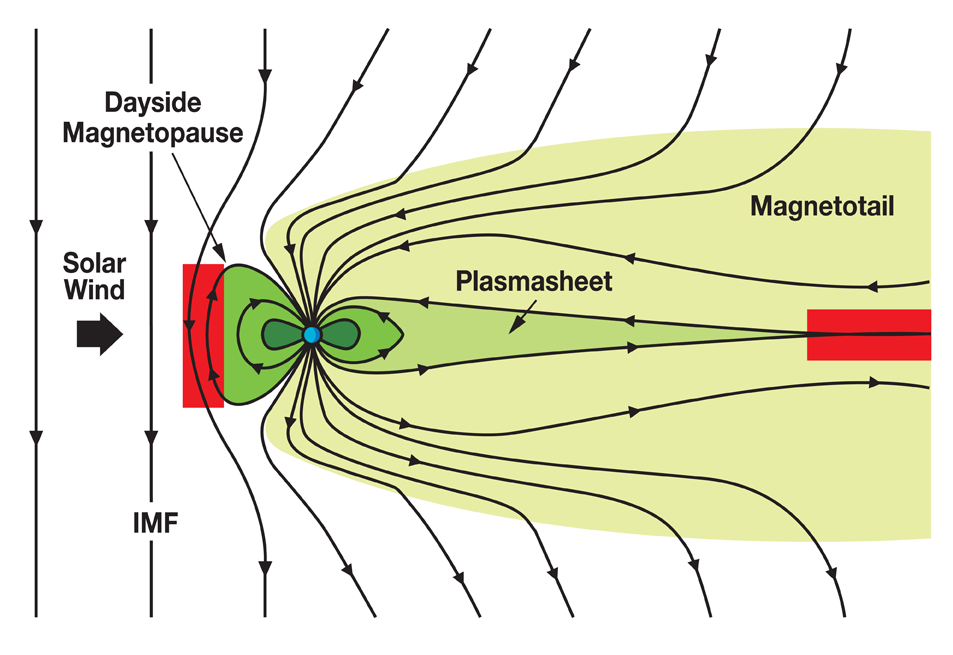
 Cosmic plasmas are threaded throughout with magnetic field lines of force. The field lines and the plasma are tied to one another and move together with the flow of the plasma. If magnetic fields in adjacent regions have opposite or significantly different orientations, the field lines and plasma can become coupled, with the individual field lines disconnecting from each other and then reconnecting with those in the adjacent region. When this happens, the energy stored in the magnetic fields is released as kinetic energy and heat. The disconnection and reconnection of the plasma and magnetic field lines takes place in a narrow boundary layer called the diffusion region.
The overarching goal of the MMS mission is to measure the plasma and the electric and magnetic fields inside the diffusion regions of Earth’s magnetosphere in order to answer the following fundamental open questions:
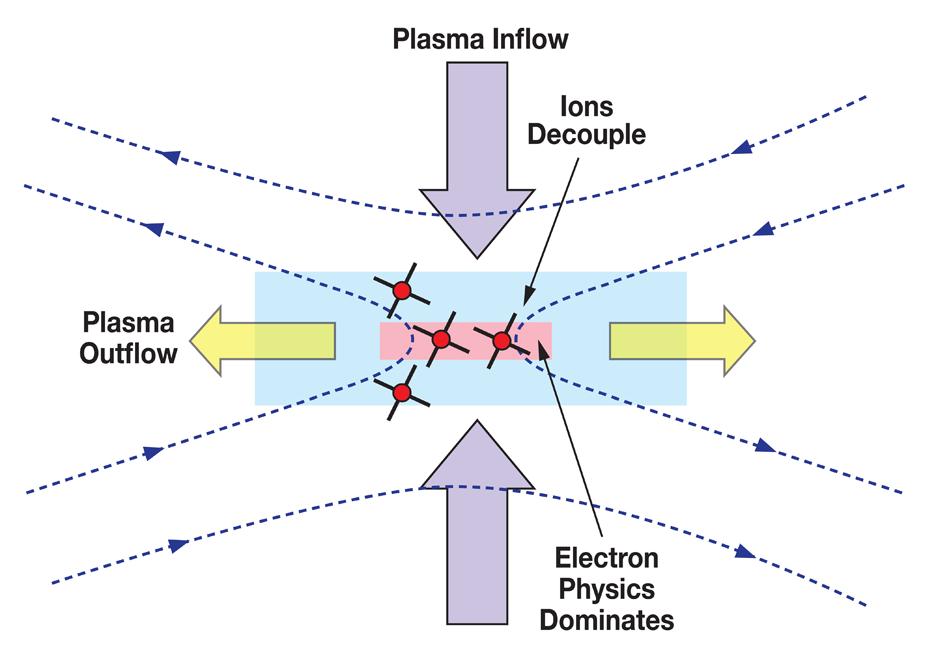 The MMS Mission exists to measure the speed and variability of an important process known as magnetic reconnection, and to relate them to boundary conditions and internal conditions within the electron diffusion region. The electron diffusion region (EDR) is small and fast moving, so MMS is specifically designed to maximize the time or spatial resolution available during its passages through the EDR. The EDR is three dimensional and must therefore be studied with a tetrahedral array of four identical spacecraft.
Magnetic fields serve as a “connective tissue” that binds plasmas together into cohesive cells sharing the same magnetic field lines. When different parts of a magnetized plasma cell move relative to each other, the magnetic field within it fights back and energy is stored in the stretched and deformed magnetic field. This energy is released when the plasma cell is divided by reconnection of the magnetic fields, disconnecting the magnetic linkage between the two regions in relative motion, and creating two distinct cells that are no longer linked, allowing the relative motion to proceed. In the reverse of that process, plasma cells that come into contact with each other may under the right conditions experience reconnection of their embedded magnetic fields such as to connect the cells together by common magnetic field lines.
Reconnection is the general term for magnetic field disconnection or connection, either of which may release energy stored in the magnetic fields. The rate of reconnection is measured by the amount of magnetic flux converted from closed to open for disconnection, or vice versa for connection. Large variations of the rate are observed or inferred, but without detailed observations of the EDR, it has been impossible to predict this rate or its variations. MMS will provide the needed observations for the first time.